
Aight, real talk. If your dog drags you down the sidewalk like a sled, you’re not alone — it’s the number-one complaint I hear from dog parents. Good news: pulling is one of the most fixable training problems in the book. Bad news: most of the advice you’ll find online ranges from “useless” to “actually harmful.” Let me walk you through what actually works.
Why dogs pull (the real reason)
Here’s the thing nobody tells you: your dog isn’t pulling because they’re dominant, stubborn, or trying to be the alpha. They’re pulling because pulling works. Every single time your dog drags you toward a tree, a squirrel, or another dog and you take a step in that direction, you just paid them for pulling. Dogs are simple economists — the behavior that earns the paycheck is the behavior they repeat.
The fix isn’t to out-strength your dog. It’s to flip the economy.
The 3-second rule
This is the foundation. Memorize it.
The leash goes tight. You stop walking. You wait 3 full seconds. The dog has to make the leash go slack again — by looking back, by stepping toward you, by anything — before the walk resumes.
That’s it. That’s the move.
What you’re teaching: a tight leash means the walk stops. A slack leash means the walk continues. Your dog is going to figure this out way faster than you’d expect, because they’re motivated — they want the walk to keep going.
Most dog parents quit on this in the first 5 minutes because they think it’s not working. Trust me on this one: the first walk is the hardest. By walk three, you’ll see the difference. By walk ten, your dog will be walking with a soft, smiling leash because their nervous system has wired it in.
The setup before you leave the house
A few things make this whole thing easier:
- Hungry dog. Train before meals when food motivation is highest. A full dog doesn’t care about your liver treats.
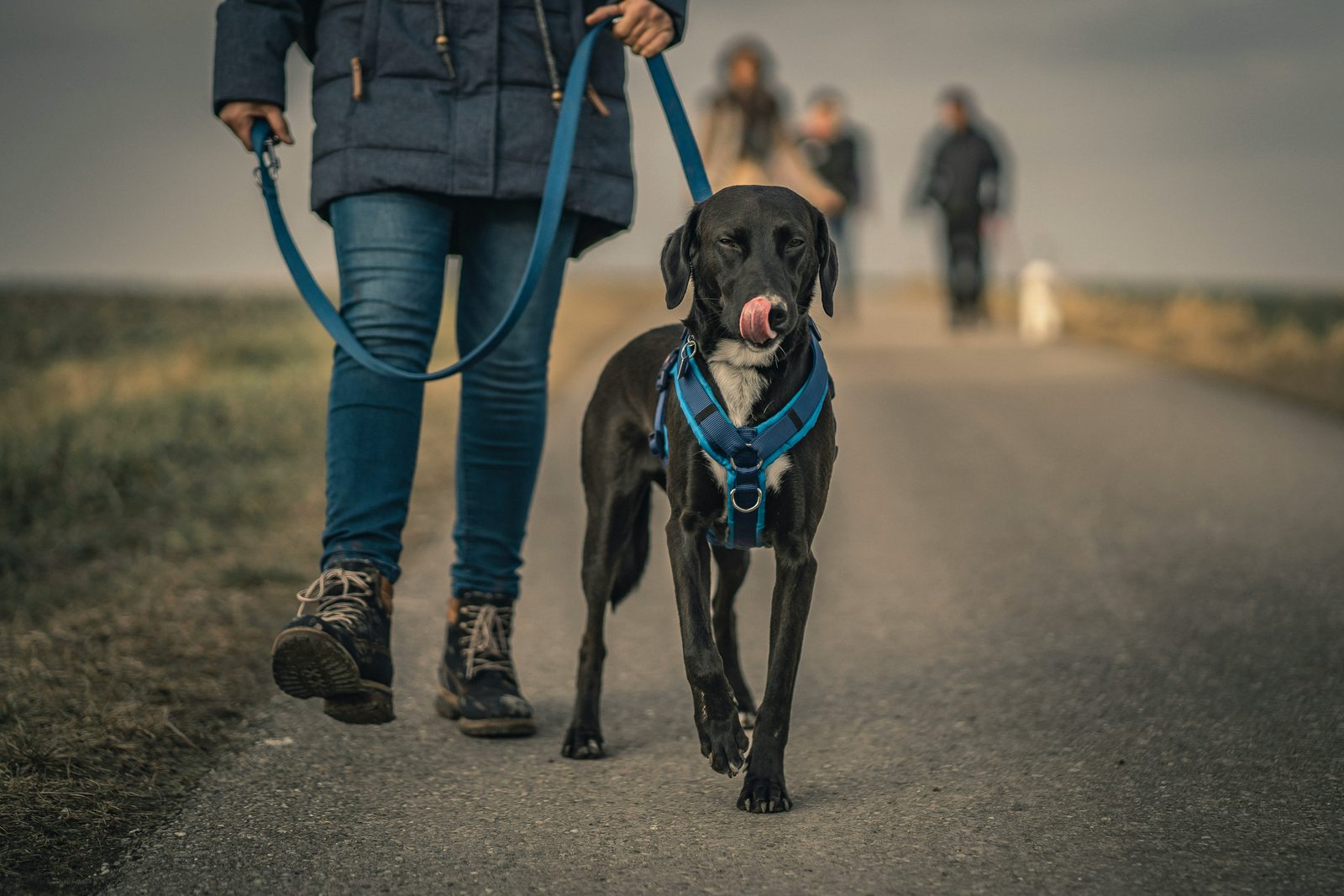
- Front-clip harness. Not a flat collar, not a back-clip harness. The front clip pivots your dog gently toward you when they pull, which makes pulling physically less rewarding. Y-shape harnesses are kindest on the shoulders.
- High-value treats. Boring kibble is not going to compete with the smell of a half-eaten pizza box on the curb. We’re talking small bits of chicken, cheese, or freeze-dried liver.
- Short sessions. Ten focused minutes beats a 45-minute marathon where you both give up halfway through.
The 4-step walking pattern
Once you’re outside, the actual rhythm looks like this:
- Walk. Move forward at a normal pace. The moment your dog is in position next to you (any leg, doesn’t have to be perfect heel), say a soft “yes” and drop a treat next to your leg.
- Pulled? The instant the leash tightens, freeze. Don’t yank, don’t say anything, don’t make eye contact. Just become a tree.
- Wait. Let your dog hit the end of the leash and figure out the puzzle. Most dogs will turn back to look at you within 3-10 seconds.
- Reset. The moment your dog looks at you OR steps toward you, mark it (“yes!”) and walk forward again. The walk continues.
That’s the loop. Walk, reward position. Tight leash, stop. Look back, walk again. Run that loop for 10 minutes a day for two weeks and the pulling habit dissolves.
Three mistakes that ruin everything
These are the wrong turns I see dog parents making. Avoid them:
Inconsistency. If you let your dog pull on the way to the dog park because “they’re excited and it’s fine,” you just taught them that pulling sometimes works. Slot machine economics — intermittent rewards are the hardest to extinguish. Either you’re training or you’re not. Pick.
Retractable leashes. These teach a dog that the leash gets longer when they pull harder. We’re trying to teach the opposite. Use a 4-6 foot fixed leash.
Punishment-based gear. Prong collars, choke chains, and shock collars suppress the pulling but don’t fix the underlying habit — and they teach your dog that the outside world is a place where bad things happen. The R+ method takes a little longer but builds a dog who actually wants to walk with you instead of one who’s afraid not to.
What about the squirrel?
Real-world walks have squirrels. And other dogs. And kids on scooters. And every other thing that pulls your dog’s attention. The 3-second rule still applies, but you also want a back-up cue — something you can use proactively when you see a trigger coming.
Pick a word — “let’s go,” “this way,” “with me.” When you see a squirrel before your dog does, say the word and step the other way before the leash goes tight. Reward heavily when your dog turns with you. You’re building a check-in cue that lives outside the leash mechanics.
How long until it sticks?
Most dogs show meaningful improvement in 2 weeks of daily 10-minute sessions. A “broken” leash habit — one you’ve had for years — can take 4-6 weeks to fully reset. Senior dogs and adolescents (6-18 months) often take longer than puppies, but every dog gets there.
The trick is not skipping a day. Pulling is a habit your dog reinforced thousands of times. The fix is a habit you reinforce a few hundred times. You don’t have to outwork your dog. You just have to be more consistent.
When to get professional help
The 3-second rule fixes the vast majority of leash-pulling cases. But there are situations where you should call in an in-person, positive-methods trainer or a board-certified veterinary behaviorist (DACVB):
- Your dog lunges, snaps, or growls at other dogs or people on leash. That’s reactivity. Same equipment but a different protocol, ideally done at distance with a pro.
- Your dog drags you despite consistent 3-second-rule work for 6+ weeks. Sometimes there’s an underlying pain issue (hip / spine / hidden injury) making the dog brace and pull — get a vet check.
- You’re being physically hurt by the pulling — pulled muscles, falls. Don’t power through; get an in-person session for the leash mechanics.
A good trainer accelerates this protocol; they don’t replace it. The science is the same.
Practice this with Coach Calvin in the Dawg app. Free to download, personalized to your dog. Coach Calvin walks you through the loose-leash protocol day by day — checklist prompts, video demos, and tailored adjustments based on your dog’s breed and energy level.
