

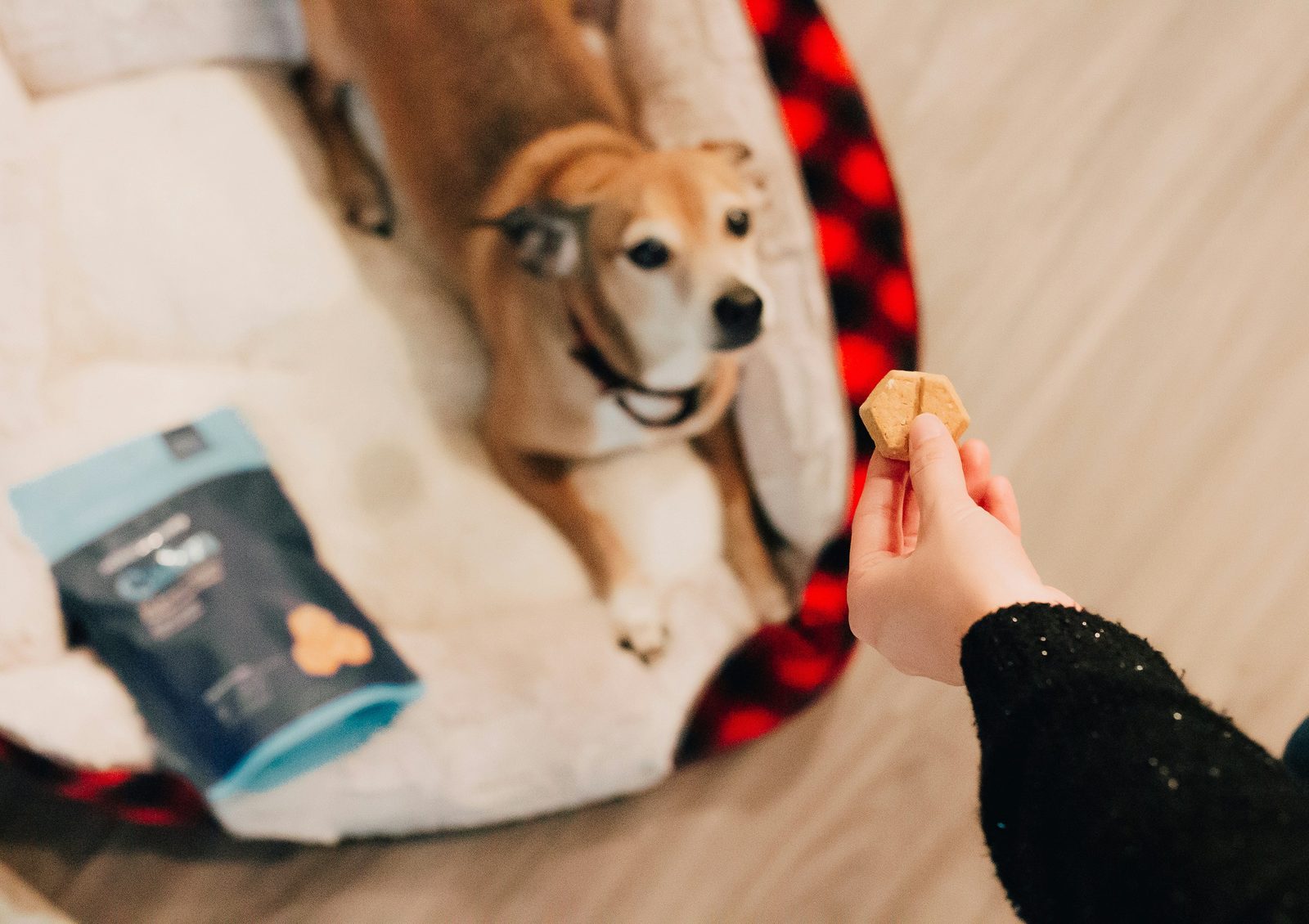
Let me get the awkward part out of the way first. Yes, this is a post about training methods. Yes, I’m going to make a case for R+ (positive reinforcement). And yes, you’re going to find plenty of people on the internet who’ll tell you that “balanced training” or “alpha dominance” works just fine for them. I’m not interested in fighting about it. I’m interested in showing you what 50 years of behavioral science says, in language that doesn’t require a PhD. Let’s go.
What “positive reinforcement” actually means
This phrase gets thrown around so much it’s lost its edges. Let me bring it back to the textbook definition, because the details matter.
In operant conditioning — the framework that explains how all animals (us included) learn from consequences — there are four possible quadrants:
- Positive reinforcement (R+): add a good thing to make a behavior more likely. Dog sits, you give a treat. Behavior repeats.
- Negative reinforcement (R-): remove a bad thing to make a behavior more likely. Dog stops pulling because the prong collar stops pinching. Behavior repeats.
- Positive punishment (P+): add a bad thing to make a behavior less likely. Dog jumps up, you knee them in the chest. Behavior decreases.
- Negative punishment (P-): remove a good thing to make a behavior less likely. Dog mouths your hand, you stand up and walk away. Behavior decreases.
“Positive” and “negative” don’t mean good or bad here — they mean adding or subtracting. All four quadrants change behavior. The science isn’t asking whether they all work. It’s asking which ones come with side effects, and how bad those side effects are.
What the research actually shows
The short version: dogs trained with R+ learn faster, retain longer, and show fewer behavior problems than dogs trained with aversive methods. That’s not me being soft — that’s the literature.
A few of the studies worth knowing:
- Hiby et al. (2004) surveyed 364 dog owners and found that dogs trained with rewards-only methods had significantly fewer problem behaviors than dogs trained with punishment-based or mixed methods.
- Herron et al. (2009) at the University of Pennsylvania found that confrontational techniques (alpha rolls, leash jerks, dominance downs) provoked aggressive responses in 25-43% of dogs studied. The “show them who’s boss” stuff doesn’t just fail to help — it can actively make dogs more dangerous.
- Cooper et al. (2014) compared shock collar training to R+ for recall and found R+ produced better results with no welfare cost, while shock training produced measurable stress signals (cortisol, ear position, lip-licking) even in dogs whose owners reported “no problem.”
- Vieira de Castro et al. (2020) in PLOS ONE compared aversive vs reward-based training across 92 dogs and 7 schools and found dogs from aversive programs showed more stress-related behaviors and pessimistic responses on cognitive bias tasks for weeks afterward.
Pile all this together and the picture is consistent: aversive methods can suppress behavior, but they don’t teach the dog what to do instead, and they come with real welfare and behavioral costs.
Why R+ works mechanically
Beyond the welfare argument, here’s the boring engineering reason positive reinforcement is just a better tool: reward-based learning produces a behavior the dog actively offers. Punishment-based learning produces a behavior the dog reluctantly avoids.
Think about the difference:
- R+ trained sit: dog sees you, offers a sit hoping for a treat. Behavior is voluntary, repeated, generalizable.
- P+ trained sit: dog sees you, sits because not sitting last time produced a leash pop. Behavior is defensive, brittle, often falls apart under stress.
Same outward behavior. Completely different internal state. One produces a confident dog. The other produces a dog walking on eggshells.
The “but my grandfather trained his dog with a rolled-up newspaper” argument
You’re going to hear this. Often. Let’s address it head-on.
Sure — you can train a dog with punishment. People have for thousands of years. Cats too, for that matter. The question isn’t whether punishment works. The question is what it costs you.
A few things the rolled-up newspaper method tends to produce:
- A dog who avoids the trainer when the trainer is angry (you call them, they hide).
- Behaviors that look obedient when you’re watching and fall apart when you’re not.
- Suppressed warning signals — a dog who used to growl before biting may stop growling, but the bite still happens, now with no warning.
- Generalized anxiety — the dog learns “bad things happen unpredictably in this environment” and starts living in a low-grade alert state.
That’s not a “good dog.” That’s a dog who’s coping. The R+ alternative produces a dog who’s actively engaged. The training takes a couple weeks longer on the front end and pays you back for the next 10 years.
”But my dog isn’t food-motivated”
I hear this constantly. Almost always wrong.
If your dog truly isn’t responding to food, one of three things is going on:
- They’re not hungry. Train before meals, not after. Sometimes the right move is to feed half their meals out of training treats and skip the bowl.
- The treat isn’t good enough. Kibble is not a reward in a distracting environment. Move up to small bits of chicken, cheese, or freeze-dried liver.
- They’re over threshold. A dog who’s anxious, overstimulated, or scared can’t eat. The environment is too much. Step back to an easier setting and rebuild.
Some dogs are toy-motivated more than food. Cool — use a tug toy as the reward. Some dogs are attention-motivated — praise and pets work fine. The currency varies; the principle (add a good thing to mark the behavior you want) doesn’t change.
What R+ doesn’t mean
Just to head off the strawman: positive reinforcement doesn’t mean “let your dog do whatever they want and bribe them to behave.” That’s not training, that’s chaos.
R+ training absolutely includes:
- Boundaries. Doors closed, baby gates up, dogs prevented from rehearsing behaviors you don’t want.
- Consequences. Negative punishment is part of R+ training. Dog jumps on you, you turn away (you removed your attention — a thing they wanted). That’s allowed.
- Management. Most “training problems” in puppies are management failures. Crate them, gate them, leash them, set them up to succeed.
- Saying no. A clear “uh-uh, leave it” is information, not abuse.
What R+ rules out is causing fear or pain to teach. That’s the line. Everything else is on the table.
What this means for your dog
If you’ve been training with positive methods and questioning whether it’s “tough enough,” it is. Stay the course.
If you’ve been using aversive tools and your dog isn’t where you want them to be, the research is clear: the tool isn’t the problem, but switching to a kinder method probably won’t slow you down — and it usually speeds things up. Worst case you’ll be exactly where you are now in a few weeks. Best case you’ll have a dog who runs toward you instead of away.
Either way: science is settled. R+ is the move.
When to get professional help
R+ alone isn’t always enough for every situation. Bring in a positive-methods trainer or a board-certified vet behaviorist (DACVB) when:
- Your dog has a bite history at Dunbar Level 3 or higher (broken skin). The dog needs a custom protocol from a pro, not a generic training app.
- Your dog is showing signs of pain (limping, reluctance to jump, snapping when handled). Pain rules out before behavior work always.
- You’ve been working consistently for 8+ weeks with no measurable progress on a specific behavior. Sometimes an in-person eye on the situation spots what we can’t see.
A good R+ trainer accelerates the work; the science doesn’t change.
Practice this with Coach Calvin in the Dawg app. Free to download, personalized to your dog. Every protocol in the Dawg notebook is R+ by default and the safety gates make sure we never suggest exposure exercises that could backfire on you.
