

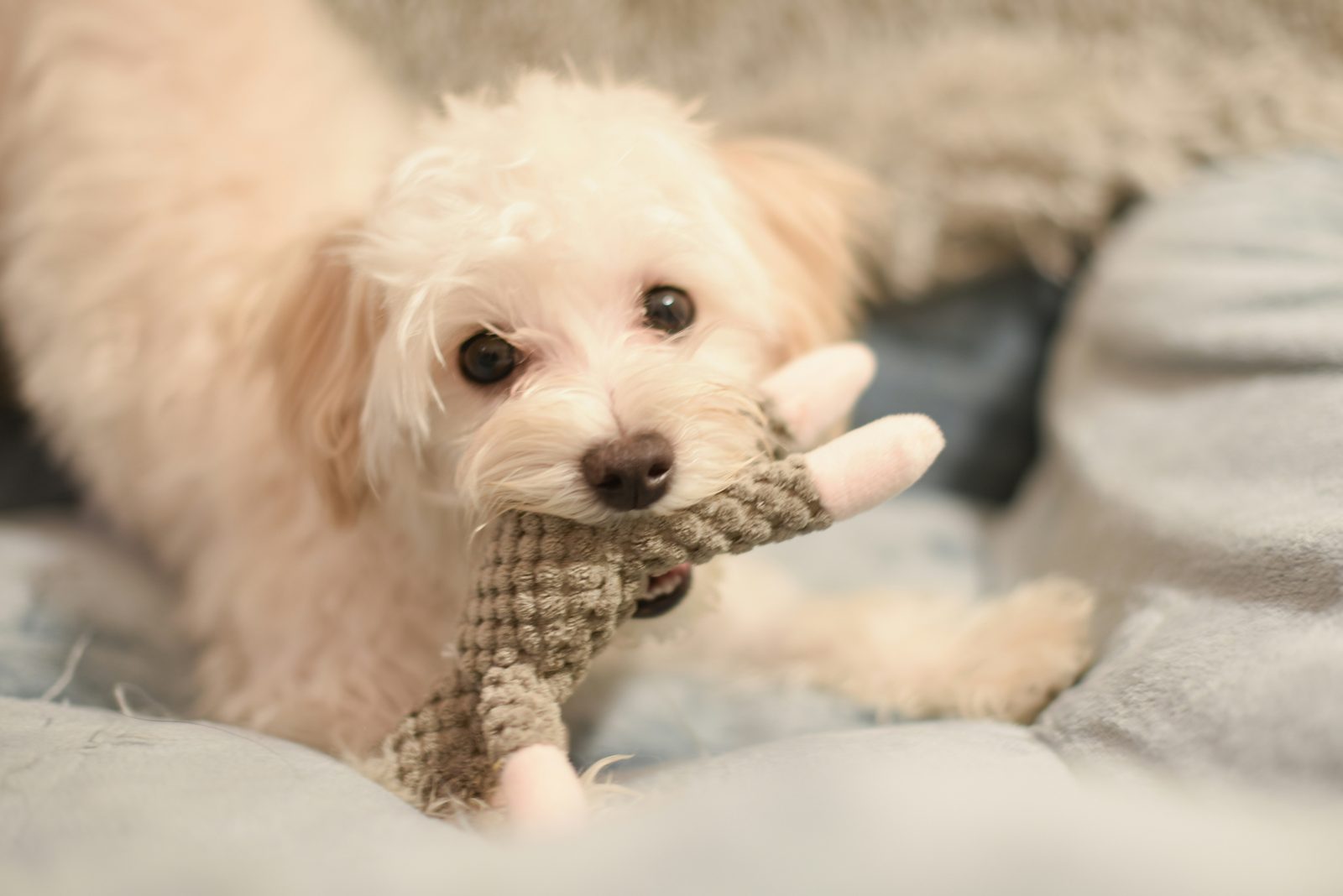
OKAY listen. You got a puppy. You are obsessed with the puppy. The puppy is also a tiny dinosaur with razor teeth who’s currently latched onto your forearm and you’re starting to wonder if you’ve made a horrible mistake. Plot twist: you have not made a horrible mistake. Your puppy is normal. And this phase ends WAY faster than you think. Let me walk you through what’s actually going on and how to fix it without becoming the bad guy.
Why puppies bite (it’s not what you think)
Real talk: puppies are not biting you because they’re aggressive, dominant, or evil. Puppies bite because:
- Their mouths are how they explore the world. They don’t have hands. Their tongue and teeth are how they learn what things are.
- Their gums HURT. Puppy teething starts around 12 weeks and runs until about 6 months. Chewing literally relieves pressure on swollen gums.
- They’re trying to play. That’s how dogs play with each other — chase, wrestle, mouth-on-skin. You’re a confusing hairless dog to them.
- They learned in the litter that biting works. Their littermates yelped, the play continued. They’ve been bite-training their siblings since they could crawl. Now they’re applying that to you.
Knowing the WHY makes this a million times easier to fix. We’re not punishing a bad dog. We’re teaching a confused baby a new social rule.
The goal: bite inhibition, then no bite
Most people think the goal is “stop biting.” Almost. The REAL goal is two-step:
Step 1: Bite inhibition. Teach your puppy how soft their mouth has to be. (Yes, even though we don’t want them mouthing us long-term, we want them to LEARN how to control their jaw pressure first. Dogs with bite inhibition who someday bite in panic? Way less damage.)
Step 2: No mouth on skin. Once bite inhibition is established (around 16-20 weeks for most puppies), we transition to “absolutely no human skin in your mouth, period.”
Skip step 1 and you have an adult dog who, if scared, has no idea how hard their teeth actually are. Skip nothing and you have a dog who knows their jaw is dangerous AND doesn’t use it on you. 💪
The yelp-and-turn method (this is THE one)
Here is the entire training protocol. Memorize it. It’s three moves:
- Puppy bites you too hard. You let out a high-pitched “YELP!” or “OW!” The puppy will usually pause from the surprise.
- You stand up and turn away for 5-10 seconds. No talking, no scolding, no looking at the puppy. You become a boring tree.
- You come back and resume gentle play. If they bite hard again, repeat.
What you’re teaching: bites that hurt = play stops. Gentle mouth = play continues. This is LITERALLY what their littermates taught them. We’re just translating it to interspecies communication.
The puppy figures this out FAST. Usually within 3-5 days you’ll notice them visibly checking themselves — they’ll start to chomp, pause, and adjust pressure. WILD. Their tiny brain is doing tiny brain math. So adorable.
Common mistakes that backfire
I see these constantly. Avoid them:
Yelling or scolding. Loud angry yelling reads to a puppy like… very exciting play noises. Lots of puppies actually escalate when yelled at. Use a high yelp, not an angry shout.
Holding their mouth shut, smacking their nose, “alpha rolling” them. All of this is on the don’t-do-list for two reasons. One: it teaches your puppy that hands are scary and unpredictable, which builds the FEAR-biters of tomorrow. Two: it doesn’t actually teach them what TO do instead. Just confuses them.
Letting them bite hands during play “for now, since they’re little.” Look at me. Your hands are not chew toys EVER. Not at 8 weeks, not at 8 months. The puppy that learns hands are fair game becomes a 70-pound adult who thinks hands are fair game. Catch this NOW.
Giving up after one bad day. Some puppies regress, especially around big developmental jumps (4 months, 6 months, “teenage” 7-12 months). Stay consistent. The protocol works. You just need to outlast their teenage moment.
Redirection is your best friend
Every time you try to interact with your puppy, have a chew toy in your hand. Or near you. Or stuffed in a pocket. When the puppy starts winding up to bite YOU, present the chew toy BEFORE the bite lands.
Rotate toys — keep 5-6 in the house, swap them in and out every few days so they stay novel. Soft toys for gentle mouthing, harder rubber for serious chewers, frozen ones for teething pain.
Frozen washcloth tip: wet a washcloth, twist it, freeze it. Cheap, instant relief for sore gums, and puppies LOVE it. You’re welcome.
The “they’re biting MORE now” problem
Sometimes around 12-16 weeks, biting gets WORSE. Don’t panic. There are usually two things going on:
Overtiredness. A overtired puppy is basically a drunk toddler — no impulse control, all chomp. If your puppy starts going feral every evening, they probably need a nap, not more play. Crate them with a frozen Kong and let them sleep.
Not enough exercise. Specifically not enough MENTAL exercise. A 20-minute sniff walk + a 10-minute training session will tire your puppy more than 2 hours of fetch. Their brains are tiny and easily exhausted in a good way.
When to call a pro
If your puppy is over 5 months old and biting that breaks skin — not just sharp puppy nips, actual injuries — it’s worth getting eyes on it from a positive-methods trainer or vet behaviorist. Most of the time this is still normal stuff that just needs a more structured plan. Occasionally there’s an underlying anxiety or pain issue worth investigating.
How long until it stops?
For most puppies: significant improvement in 2-3 weeks of consistent yelp-and-turn. Mouth-totally-soft by 16-20 weeks. Zero mouth-on-skin by 6 months IF you’ve been consistent.
If you’re 4 weeks in and seeing zero change, the most likely thing is inconsistency — someone in the house is still wrestling with the puppy, or someone occasionally lets the biting happen. Everyone in the family needs to be on the same protocol. Even the kids. ESPECIALLY the kids.
Practice this with Coach Danielle in the Dawg app. Free to download, personalized to your dog. Inside the app, Danielle walks you through the puppy curriculum day by day — bite inhibition, redirection games, the chew rotation — plus a daily “is my puppy biting MORE today?” check-in that diagnoses what’s going on (tired? hungry? teething?) before it spirals.
Your puppy is gonna grow out of this so fast you’ll miss it. Promise. Now go give them a frozen washcloth. 🎉
